文
A

At the end of May, an app called Poke Genie quickly climbed into the top five of the App Store’s top-grossing utilities chart in many markets worldwide. In the utilities category, where revenue performance is usually stable, ranking fluctuations are generally not as dramatic as those seen in games, short dramas, or AI apps. Therefore, Poke Genie’s rapid ranking jump and revenue growth across multiple markets in such a short period are particularly worth watching.

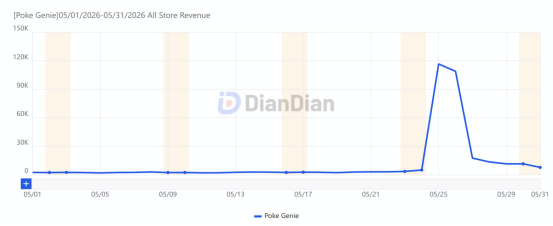
A closer look at the app’s daily revenue trend through DianDian shows that Poke Genie’s revenue breakout did not last throughout the entire month, but was highly concentrated over two days at the end of May. For a utility app that does not rely on large-scale advertising and rarely appears in the mainstream spotlight, this short-term revenue lift looks more like a surge driven by the concentrated release of specific demand, rather than conventional organic growth or random chart volatility.
This makes the question more specific: what kind of users would concentrate their spending on a third-party tool within such a short time window? And what kind of scenario could give a seemingly niche companion app such clear monetization elasticity all at once?
What is truly worth noting about this growth is not merely a short-term chart surge by a niche utility app, but the other type of monetization space it reveals within long-running game ecosystems. When a game operates for many years and its gameplay mechanics, event systems, and player coordination barriers continue to rise, users’ willingness to pay does not necessarily occur only inside the game. It can also spill over beyond the official product. To make pre-battle decisions, cross-region coordination, resource management, and progression planning more efficient, players are also willing to pay for third-party tools.
Poke Genie is a typical beneficiary of this spillover demand. To understand why it suddenly converted concentrated payments at the end of May, we need to start with the product itself.
From an IV calculator to a “battle advisor” for Pokémon GO players
The app’s name alone makes it easy to associate it with the world-famous anime IP Pokémon, and its icon design is also inspired by a classic item from the Pokémon world: the Pokédex.

That is indeed the case. According to developer associations and public information collected by DianDian, Poke Genie has no direct relationship with the official Pokémon brand, but it is closely tied to a phenomenal mobile game that has been live for nearly a decade: Pokémon GO.

Poke Geniewas released in September 2016, only one month after Pokémon GO launched. It first became known among players because it solved one of that game’s very typical problems that the official game did not present sufficiently: how to determine whether a Pokémon is worth raising.
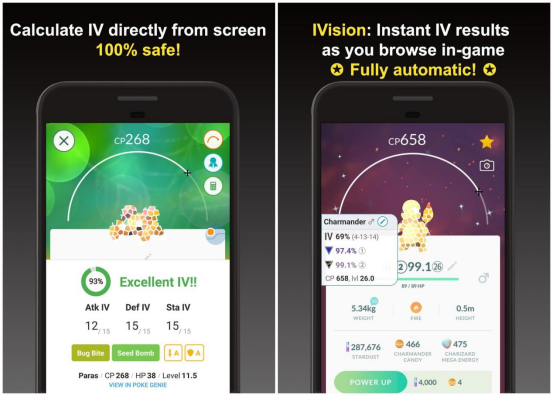
In the classic mainline Pokémon games, every Pokémon has hidden attributes, commonly known among players as IVs, or Individual Values. These are usually divided into six stats: HP, Attack, Defense, Special Attack, Special Defense, and Speed, with each stat ranging from 0 to 31. In Pokémon GO, however, the IV system is greatly simplified into three stats: Attack, Defense, and Stamina.
For casual players, IV represents a Pokémon’s “growth potential.” For advanced players, IV not only affects the priority of resource investment, but also directly relates to battle performance, PvP ranking competitiveness, and even collection value. Core resources in Pokémon GO, such as Stardust, Candy, and Technical Machines, are not unlimited. Every power-up, evolution, and move change carries a cost. As a result, IV calculation became a key decision-making tool that meets players’ core needs and helps them avoid wasting resources.
This was Poke Genie’s original core value: it effectively took on the role of providing more professional player education and guidance on behalf of the official game. At the same time, its evolution from early screenshot-based reading of Pokémon GO page information to calculate IVs, to today’s more convenient experience supporting screen reading and automatic browsing scans, has also been one of the decisive factors that allowed it to stand out from a crowd of guide-oriented products.

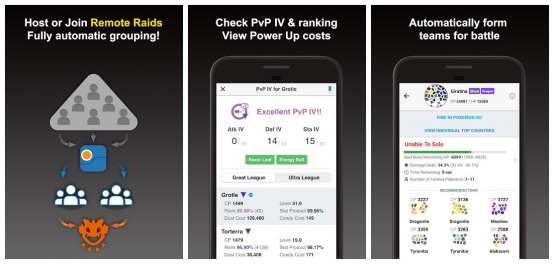
In addition to IV calculation, another core capability of Poke Genie is remote raid coordination (Remote Raid Coordinator).This feature corresponds to the Remote Raid gameplay mechanic introduced by Pokémon GO in April 2020 during the pandemic. Through this mechanic, players could break through the original local-area limitations of raids and team up with players worldwide to challenge powerful bosses, earning rare resources such as Legendary Pokémon, Mega Energy, and Rare Candy. The popularity of raid participation brought by this mechanic also became the opportunity for Poke Genie to upgrade from a simple calculator into a “battle advisor.”

Supporting functions such as the Battle Simulator (Battle Simulator), Pokédex, collection management (Collection Management), and other features jointly improved the full player experience from catching to progression and battling, covering multiple key touchpoints in the daily gameplay of advanced Pokémon GO players.
Therefore, Poke Genie is essentially an all-in-one game companion tool built on the long-running ecosystem of Pokémon GO. It does not directly produce game content or change game rules. Instead, by continuously studying players’ core behaviors and addressing their needs, it keeps improving its features and experience, thereby establishing authority among core players. For casual players, it lowers the understanding barrier; for advanced players, it improves experience and efficiency. After years of operation, it has ultimately evolved into the most suitable real-world “Pokédex.”
Remote Raid scenarios drove a revenue surge
For a companion tool that is deeply tied to a game product and embedded in player needs, the reason behind its May data growth, especially the surge in revenue, can be traced clearly.
According to DianDian, Poke Genie recorded more than 120,000 global downloads in May, with estimated revenue exceeding US$340,000, up more than 338% MoM. Compared with download changes of less than 10%, it is clear that the growth mainly came from existing users. A further look at daily trends shows that the peak period of its breakout was concentrated on the 25th and 26th at the end of the month.

Considering factors such as platform revenue settlement delays, this period highly overlaps with Pokémon GO’s Super Mega Falinks Raid Day event at the end of May. In addition, the appearance of Raid Day exactly matches the use case of Poke Genie’s most important paid feature, Remote Raid Coordinator.

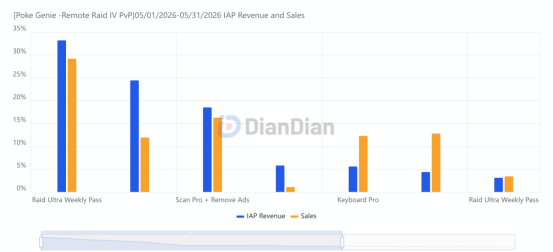
Looking at the May in-app purchase revenue share of different revenue items in major markets, the subscription items directly related to the Raid Day scenario, Raid Ultra Weekly Pass and Raid Ultra, together contributed nearly 60% of revenue. This structure further confirms that Poke Genie’s May revenue growth was not driven by the natural use of ordinary utility functions, but was highly related to players’ concentrated demand for remote teaming, queue efficiency, and event participation efficiency during Raid events.

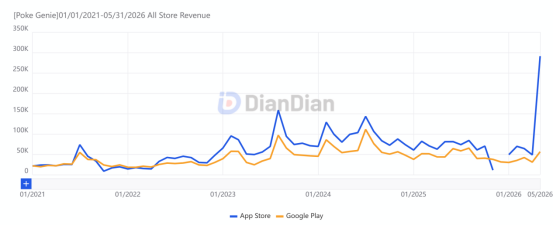
Looking at Poke Genie’s revenue trend over the past five years, its revenue peaks do not appear in a stable cycle, and they do not fully align with the overall revenue trend of Pokémon GO. Comparing this with DianDian’s app event detail data, the appearance of revenue peaks is indeed related to events, but the decisive factor is whether the event features bosses such as Mewtwo, Rayquaza, or Dialga, which have high popularity, high battle value, or high collection value. In other words, only when a limited-time event overlaps with players’ preferred targets will demand be amplified in a concentrated way.
It can therefore be judged that Poke Genie’s growth did not come from paid acquisition or organic new users, but from long-accumulated advanced users being reactivated and paying in concentration at specific event nodes. For a utility product, this is more valuable than a one-off increase in downloads, because it shows that the product has already become embedded in users’ core gameplay flow.

It is worth noting that, in terms of revenue platform share, the App Store channel contributed a relatively leading share. The reason may be related to platform ecosystems: Android’s more open environment gives users more choices around Pokémon GO companion tools, IV calculators, guide websites, and community tools. By contrast, alternative tools in the iOS ecosystem are relatively limited, and users are more accustomed to completing payments through mature apps inside the App Store. In addition, this data breakout was concentrated on the App Store channel, which may indicate that the platform has a higher proportion of Raid players with strong payment capacity.
On the other hand, Poke Genie’s ability to operate for nearly 10 years on iOS is also related to its long-standing emphasis on being a safe, accurate, and fast Pokémon GO companion tool. This sense of “compliance” is especially important on iOS.
Opportunities and boundaries for companion tools built around popular game IPs
The most noteworthy part of the Poke Genie case is not just that in May it achieved an explosive growth spike, but that through its long-running operation case, it proves a type of product opportunity that has long existed but is often underestimated. When a game has a sufficiently large user base, a sufficiently long lifecycle, and continuously expanding gameplay systems, players will naturally generate cognitive, efficiency, strategy, and collaboration needs outside the game.
Similar cases can be seen across many popular games, such as the Artifact system in Genshin Impact and the Relic system in Honkai: Star Rail; Diablo’s gear affixes, skill trees, build combinations, drop mechanics, and damage calculations; and even the equipment systems and lineup counter relationships in Honor of Kings and Golden Spatula. When game mechanics become too complex for official guidance to fully cover, and players must make high-cost decisions, third-party tools gain room to exist.
The inspiration from Poke Genie is that the value of these tools does not lie in simply reposting guides, but in translating obscure mechanics into results that players can understand, execute, and compare. Whoever can more accurately connect game mechanics with player decisions may become the “second-layer product” within that game ecosystem.
At the same time, compliance boundaries are the survival red line for such products. As mentioned earlier, Poke Genie has maintained a sense of “compliance” on iOS. For popular IPs, names, icons, character images, promotional materials, and even product pages may all fall within the scope of rights-holder protection. If a product involves reading game memory, simulating clicks, automating accounts, bypassing restrictions, or calling unauthorized APIs, it may be deemed a plug-in, cheating tool, or non-compliant automation product. At best, it may face app store removal, feature rectification, account bans, and loss of user trust; at worst, it may trigger legal action from the game publisher.
Monetization further amplifies these risks. Many game companies are relatively tolerant of free mods, guide communities, or non-commercial tools, but once a third-party developer charges fees around their IP, the publisher’s tolerance is almost zero. A typical example is the widely discussed case in the gaming community in which CD Projekt RED issued a DMCA takedown notice against a paid Cyberpunk 2077 VR Mod.

For developers, copying the model directly is not advisable. The opportunity for this type of product lies in identifying real player pain points within complex game mechanics and productizing them under compliant conditions, then continuously following up with operations while waiting for the product’s own “Raid Day” to arrive.